§ Journal · May 28, 2026
Best Aftermarket Bar and Chain Combos — Value Guide
Compare Oregon, generic, and OEM bar+chain sets for Stihl, Husqvarna, Echo. Focus on fitment specs (pitch, gauge, DL) and price.
Best Aftermarket Bar and Chain Combos — Value Guide
If your chainsaw is cutting crooked, throwing fine dust instead of chips, or eating through chains faster than it should, the problem is often not just chain sharpness—it’s the whole cutting system. A worn bar, mismatched chain, or tired drive sprocket can make even a good saw feel weak.
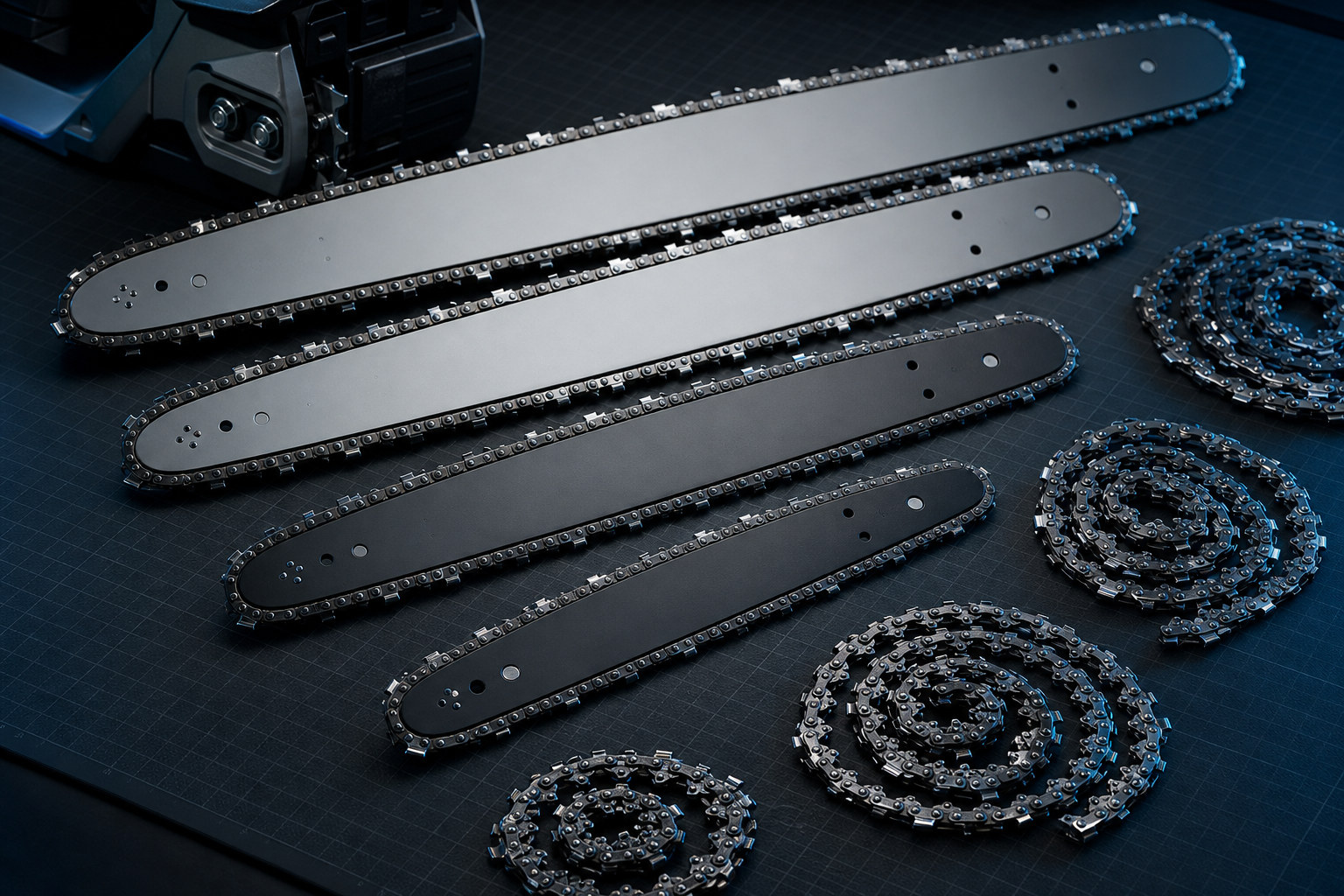
For homeowners and arborists, aftermarket bar-and-chain combos can be one of the best value upgrades available. The right combo often costs less than buying an OEM bar and chain separately, and in many cases performs just as well for firewood cutting, storm cleanup, property maintenance, and general tree work.
This guide compares Oregon, generic/import, and OEM bar-and-chain sets for popular Stihl, Husqvarna, and Echo saws, with a focus on the fitment details that actually matter:
- Pitch
- Gauge
- Drive link count (DL)
- Bar mount pattern
- Price tier
- Best use case
Understanding fitment: pitch, gauge, and drive links
Before comparing brands, it’s worth covering the three specs that determine whether a chain will fit your bar and saw:
Pitch
Pitch is the size of the chain, measured between drive links. Common chainsaw chain pitches include:
- 3/8” low-profile (3/8 LP) — common on small homeowner saws
- .325” — common on mid-size saws
- 3/8” — common on pro saws and larger farm/ranch saws
- .404” — larger professional applications
Your drive sprocket, bar nose sprocket, and chain pitch must match.
Gauge
Gauge is the thickness of the drive link where it rides in the bar groove. Common gauges include:
- .043”
- .050”
- .058”
- .063”
The chain gauge must match the bar groove gauge.
Drive links (DL)
Drive link count is the number of chain drive links required for a specific bar and mount combination. Two 18-inch bars can use different DL counts depending on bar design and mount pattern, so bar length alone is not enough to order the correct chain.
Mount pattern
The guide bar must also match the saw’s bar stud spacing, tensioner location, and oil hole pattern. This is why a Stihl bar does not automatically fit a Husqvarna, even if pitch, gauge, and length are similar.
For the most common replacement setups:
- Stihl homeowner saws often use 3/8 LP, .043 or .050 gauge
- Husqvarna homeowner/farm saws often use .325 or 3/8 LP, usually .050 gauge
- Echo saws commonly use 3/8 LP or .325, often .050 gauge
Always verify the original bar stamp or your saw model’s spec before ordering.
Oregon vs generic vs OEM bar-and-chain combos
When shopping for combo kits, most buyers fall into one of three lanes: established aftermarket like Oregon, low-cost generic kits, or OEM replacements from Stihl, Husqvarna, or Echo.
Oregon combos
Oregon is usually the safest aftermarket choice. Their bars and chains are widely available, fitment is well documented, and quality is consistently good for the money.
Typical specs available:
- 14” to 20” common consumer lengths
- 3/8 LP, .325, and 3/8 pitch
- .043, .050, .058, and .063 gauge options
- Drive link counts matched for common Stihl, Husqvarna, and Echo models
Price tier:
- Budget-midrange
- Roughly $30–$55 for many homeowner combos
- $50–$90+ for larger or pro-grade setups
Pros:
- Good steel quality and bar durability
- Chains usually cut clean and sharpen predictably
- Easy to find replacement chains later
- Better consistency than no-name imports
Cons:
- Usually more expensive than generic sets
- Not always identical to OEM cutting feel
- Some fitment confusion if ordering by bar length only
For most homeowners, Oregon tends to be the best balance of price, fit, and performance.
Generic/import combos
Generic kits are often the cheapest option online. These can be attractive if you need a bar and chain fast and don’t want to spend much on an older saw.
Typical specs available:
- Common lengths like 14”, 16”, 18”, and 20”
- Usually .050 gauge offerings dominate
- Most frequently available in 3/8 LP and .325
Price tier:
- Lowest cost
- Roughly $18–$35 for common combos
Pros:
- Lowest upfront cost
- Fine for light-duty occasional cutting
- Good for backup saws or resale prep
Cons:
- Quality control varies a lot
- Hardness and wear life can be inconsistent
- Chain stretch is often greater
- Fitment listings may be inaccurate
- Oil hole alignment and bar groove finish can be less precise
A generic set can be a decent short-term value, but it’s usually not the best choice for heavy seasonal use, firewood volume, or arborist work.
OEM bar-and-chain sets
OEM bars and chains from Stihl, Husqvarna, or Echo generally offer the closest match to original saw setup and factory performance.
Price tier:
- Midrange-premium
- Roughly $45–$80 for many homeowner setups
- $80–$140+ for larger pro bars and chain combinations
Pros:
- Exact intended fitment
- Strong confidence in oiling and tensioner compatibility
- Often excellent chain performance out of the box
Cons:
- Highest cost in many cases
- Limited flexibility if you want to change cutting setup
- Sometimes not enough performance gain to justify the premium over Oregon
For professional users who want to keep a saw fully OEM, they make sense. For value-focused buyers, aftermarket often wins.
Fitment by brand: Stihl, Husqvarna, and Echo
Stihl combos
Stihl fitment is where buyers make the most mistakes, because many Stihl saws use Stihl-specific bar mounts and some use .043 gauge Picco-style setups.
Common examples:
- Small homeowner saws: 3/8 LP, .043 or .050
- Mid-size saws: .325, .063 or .050
- Larger pro saws: 3/8, .050 or .063
A common 16” Stihl setup might be:
- 3/8 LP
- .043” gauge
- 55 DL
But another 16” Stihl may use:
- 3/8 LP
- .050” gauge
- 55 or 56 DL, depending on bar pattern
This is why you should never order a Stihl combo based on “16-inch” alone.
Best value note: Oregon-compatible Stihl combos usually save noticeable money over OEM while maintaining reliable cut quality.
Husqvarna combos
Husqvarna models often use more standardized aftermarket fitments, making them easier to shop for than Stihl.
Common setups:
- Smaller saws: 3/8 LP, .050
- Mid-size saws: .325, .050
- Larger saws: 3/8, .050 or .058
A common 18” Husqvarna setup might be:
- .325 pitch
- .050 gauge
- 72 DL
Another common homeowner setup:
- 3/8 LP
- .050 gauge
- 62 DL
Best value note: Husqvarna owners often get excellent value from Oregon bars and chains because fitment support is broad and pricing is usually well below OEM.
Echo combos
Echo saws are often underrated, and many use straightforward, common fitments that are aftermarket-friendly.
Typical Echo setups include:
- 3/8 LP, .050
- .325, .050
- Occasional larger 3/8 full-size setups
Example common fitments:
- 14” or 16”: 3/8 LP, .050, 52–59 DL
- 18”: .325, .050, 72 DL on some models
Best value note: Echo owners can often buy aftermarket combos with good confidence, but should still verify mount and DL count carefully.
Price tiers and what you actually get
Budget: under $35
Usually generic/import kits.
Best for:
- Very light homeowner use
- Older saws with limited value
- Spare setups for occasional storm cleanup
Tradeoffs:
- Faster chain stretch
- Shorter bar life
- More variability in cutter consistency
Midrange: $30–$60
This is the sweet spot for most homeowners, and where Oregon usually lands.
Best for:
- Firewood cutters
- Property owners
- Frequent seasonal use
- Users who want dependable fit and service life
Tradeoffs:
- Slightly more cost upfront
- Not always “factory original” branding
Premium: $60 and up
Typically OEM or heavier-duty aftermarket/pro bars.
Best for:
- Arborists
- Daily-use saws
- Buyers who want exact OE feel
- Larger displacement saws
Tradeoffs:
- Higher replacement cost
- Often marginal value gain for casual users
Our picks
If you’re buying from our catalog, these are the bar-and-chain combo types we typically recommend by value tier and use case.
Best overall value: Oregon bar-and-chain combos
For most Stihl, Husqvarna, and Echo owners, an Oregon combo matched exactly by pitch, gauge, drive links, and mount pattern is the smart buy.
Why:
- Better consistency than generic kits
- Lower price than OEM in most cases
- Easy to get matching replacement chains later
Best for:
- Homeowners
- Farm/ranch users
- Firewood cutting
- General maintenance saws
Look for:
- Correct pitch
- Correct gauge
- Exact DL count
- Correct fitment for your saw family
Best budget option: generic combo sets for light use
If your saw is older, lightly used, or only comes out a few times a year, a generic bar-and-chain combo can make sense.
Why:
- Lowest upfront cost
- Fine for backup or occasional duty
Best for:
- Infrequent users
- Temporary replacements
- Budget-first buyers
Avoid these if:
- You cut a lot of hardwood
- You rely on the saw regularly
- You want long chain life and better edge retention
Best OEM-style choice: direct replacement OEM sets
If you want factory-correct setup for your Stihl, Husqvarna, or Echo, OEM sets are still the benchmark for exact original fit.
Why:
- Predictable installation
- Correct oiling and mount geometry
- Good option for newer, higher-value saws
Best for:
- Professional users
- Owners who prefer OE parts
- Saws still kept to factory spec
Don’t forget the sprocket
If you’re replacing multiple chains or your current chain shows uneven wear, inspect the drive sprocket too. A worn sprocket can prematurely wear out a new chain and bar.
As a rule:
- Replace the sprocket after about 2 chains, or sooner if visibly worn
- Make sure sprocket pitch matches the chain
- Rim sprocket systems are often easier and cheaper to service than spur sprockets
A fresh combo on a worn sprocket is false economy.
FAQ
Is Oregon as good as OEM?
For many homeowner and farm/ranch applications, Oregon is close enough in performance that it offers better overall value. OEM can still be worth it for exact-fit preference or professional use.
Can I order by bar length only?
No. You need at least:
- Bar mount/fitment
- Pitch
- Gauge
- Drive link count
Bar length alone is not enough.
What does DL mean on a chainsaw chain?
DL means drive links. It is the number of drive links in the chain loop and is critical for proper fit.
Can I change from .043 to .050 gauge?
Only if the bar groove is made for that gauge. The chain gauge must match the bar gauge.
Can I switch from .325 to 3/8 chain?
Only if the drive sprocket, bar nose, and chain are all converted to the same pitch. Pitch components must match.
Are cheap bar-and-chain combos worth it?
They can be, for light occasional use. For regular cutting, Oregon or OEM usually costs less in the long run due to better wear life and more reliable fitment.
Should I replace the sprocket with the bar and chain?
If the sprocket shows wear or has already run several chains, yes. It helps protect the new chain and improves overall cutting system life.
If you want, I can also turn this into a catalog-ready version with product callouts for specific Stihl, Husqvarna, and Echo models, such as MS 170/MS 250, 435/450 Rancher, or Echo CS-310/CS-400.
Find the right part on Amazon
Check price, stock and fitment — ships direct from Amazon.
§ Parts


