
§ Journal · May 28, 2026
Full Chisel vs Semi-Chisel Chain — Which One Should You Buy?
Head-to-head comparison. Full chisel = faster but dulls faster. Semi-chisel = more forgiving. Help buyer match to use case.
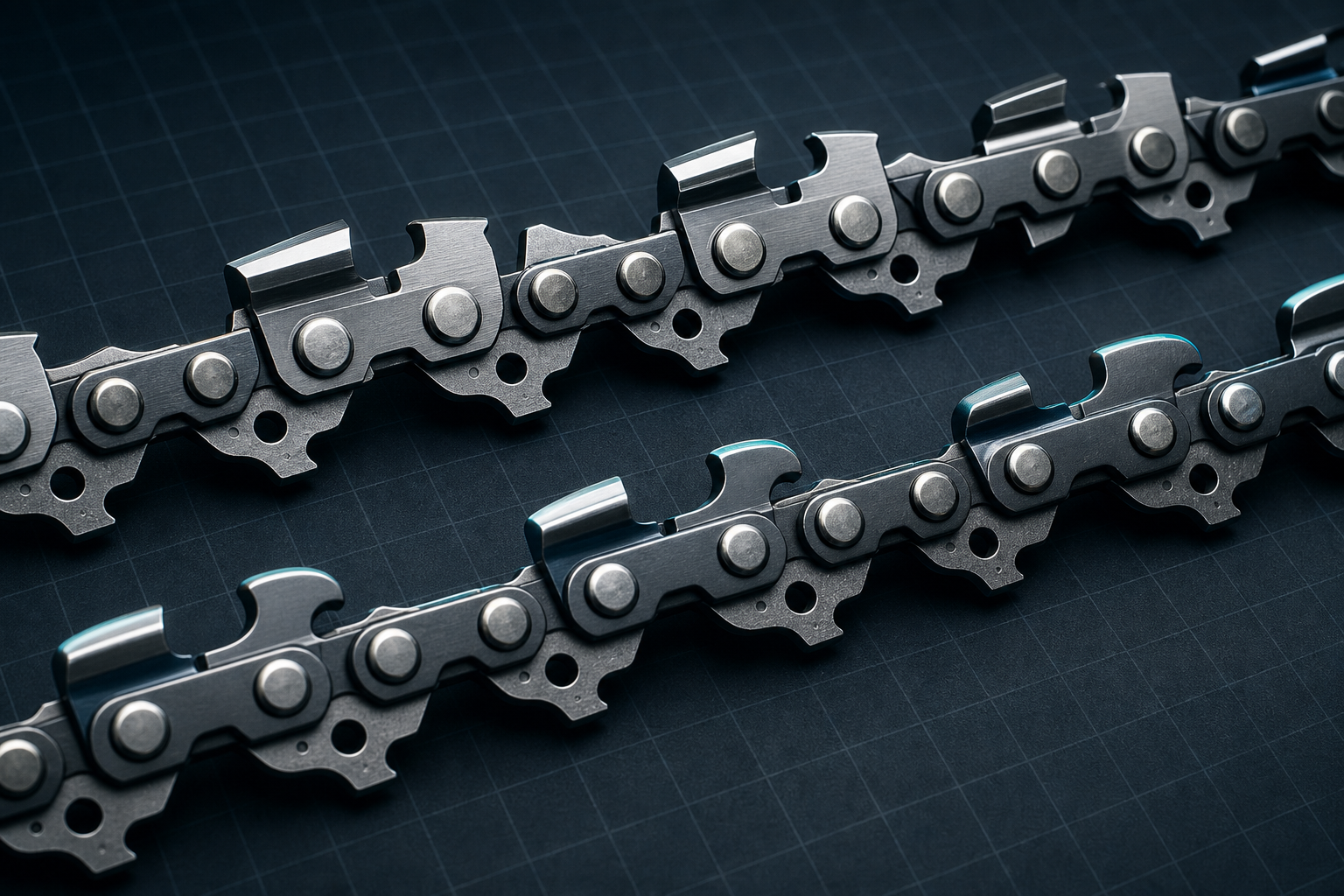
Full Chisel vs Semi-Chisel Chain — Which One Should You Buy?
If you’re replacing a chainsaw chain, one of the most important choices is full chisel vs semi-chisel. Both are common on homeowner, farm, firewood, and professional saws, but they behave very differently once they touch wood.
The short version:
- Full chisel chain cuts faster in clean wood
- Semi-chisel chain stays sharp longer in dirty, frozen, or mixed conditions
- Full chisel is usually the better fit for experienced users chasing production
- Semi-chisel is often the smarter buy for homeowners and general-purpose cutting
If you’ve ever wondered why one chain rips through hardwood but seems to lose its edge quickly, while another feels a little slower but keeps working all day, the cutter shape is a big reason why.
Full chisel vs semi-chisel at a glance
The main difference is the shape of the cutter corner.
- Full chisel chain has a sharp, square-cornered cutting tooth
- Semi-chisel chain has a more rounded working corner
That small geometry change affects cutting speed, edge retention, sharpening feel, and how the chain handles contamination like bark grit, mud, and stumps.
Quick comparison
| Feature | Full Chisel | Semi-Chisel |
|---|---|---|
| Cutting speed | Faster | Moderate |
| Edge retention in dirty wood | Lower | Better |
| Best for | Clean timber, high production | Firewood, storm cleanup, mixed conditions |
| Sharpening tolerance | Less forgiving | More forgiving |
| User type | Experienced users, arborists, loggers | Homeowners, landowners, general users |
| Vibration/feel | More aggressive | Smoother, more forgiving |
In practice, the choice is less about “which is best” and more about what you cut, how often you sharpen, and how clean your wood is.
Cutter performance: speed vs durability
Full chisel: maximum cutting speed
Full chisel chain is popular because it is aggressive and fast. The square-corner cutter slices wood fibers efficiently, especially in:
- Clean softwood
- Clean hardwood
- Fresh-felled timber
- Bucking and limbing where speed matters
If you run a pro-grade saw and want strong feed rate with less pressure, full chisel usually feels more lively. Arborists and production cutters often prefer it because it saves time over the course of a day.
The tradeoff is that the sharp corner is more vulnerable. Hit a little dirt, sandy bark, charred wood, frozen contamination, or a hidden rock near the base of a log, and the edge can dull noticeably faster.
Semi-chisel: slower, but more forgiving
Semi-chisel chain has a rounded corner that gives up a bit of peak cutting speed, but in exchange it holds its edge better in less-than-perfect conditions.
It’s often the better real-world chain for:
- Firewood cutting
- Felling trees with dirty bark
- Storm cleanup
- Cutting deadfall
- Frozen wood
- Occasional contact with dusty or abrasive surfaces
For many buyers, especially homeowners, semi-chisel ends up being “faster overall” because it stays usable longer between sharpenings. A chain that is slightly slower but still sharp after several cuts often beats a faster chain that loses efficiency early.
Sharpening, maintenance, and user skill
One of the biggest differences between these chain types shows up on the workbench.
Full chisel needs more precision
To keep full chisel chain performing at its best, sharpening angles need to stay consistent. The cutter shape rewards accuracy, but it also exposes sloppy filing more quickly.
That means full chisel is best for users who:
- Sharpen frequently
- Use proper file guides or grinders
- Know how to maintain top plate angle and side plate shape
- Watch raker depth closely
If you maintain it well, the payoff is excellent cutting speed. If you don’t, performance falls off quickly.
Semi-chisel is easier to live with
Semi-chisel is generally more forgiving to sharpen by hand. Its rounded cutter profile tolerates slight variations better, which is one reason it remains so popular with non-professional users.
It’s a strong choice if you:
- Sharpen by hand in the field
- Don’t want to touch up the chain constantly
- Sometimes cut wood that isn’t perfectly clean
- Value consistency over maximum aggression
For landowners and casual users, that easier maintenance can matter more than the last bit of speed.
Fitment, chain specs, and what actually matters when buying
When choosing either full chisel or semi-chisel, you still need to match the chain to your saw correctly. Cutter style does not replace fitment specs.
The key specs are:
- Pitch: common sizes include .325”, 3/8”, low-profile 3/8”, and .404”
- Gauge: common sizes include .043”, .050”, .058”, and .063”
- Drive link count: must match the guide bar
- Bar length compatibility
- Saw make/model
- Drive sprocket compatibility
For example, a 20” chain for a Husqvarna might be:
- Pitch: 3/8”
- Gauge: .050”
- Drive links: 72
But another 20” setup could use .325” pitch or a different drive link count entirely. The length stamped on the bar is not enough by itself.
Pricing tiers
While prices vary by brand and series, chains usually fall into a few broad tiers:
Budget tier
- Often best for occasional use
- Usually semi-chisel, low-kickback, or consumer-focused designs
- Good for homeowners who cut a few times per year
Mid-range tier
- Better steel, better edge life, more precise grind
- Available in both full chisel and semi-chisel
- Best value for frequent firewood cutters and landowners
Pro tier
- Built for high-output saws and daily use
- Often available in full chisel for speed-focused cutting
- Best for arborists, loggers, and users who sharpen often
As a rule, paying more for a better chain makes sense if you cut regularly. A high-quality chain usually tracks straighter, sharpens better, and lasts longer.
Bar-and-chain combos and sprockets: when chain choice affects the rest of the setup
If you’re rebuilding a worn cutting system, it may make more sense to replace more than just the chain.
Bar-and-chain combos
A bar-and-chain combo is a smart buy when:
- The bar rails are worn
- The nose sprocket is rough
- The old chain has stretched unevenly
- You want to change bar length or chain family
For homeowners, combos are often the easiest way to get a fresh, matched setup without guessing at fitment. For pros, they’re useful when standardizing multiple saws around a preferred pitch and gauge.
If you’re moving from a slower consumer chain to a more aggressive full chisel chain, make sure the bar and saw are rated appropriately and that oiling is in good condition.
Sprockets matter more than many buyers think
Your chain has to match the drive sprocket pitch. If your saw uses a worn sprocket, even a brand-new chain won’t perform properly.
Replace the sprocket when:
- Teeth show visible hooking or wear
- You’ve gone through multiple chains on the same sprocket
- You’re switching pitch
- Chain tension and drive feel have become inconsistent
A worn sprocket accelerates chain wear and can cause poor cutting behavior. If you’re investing in premium full chisel chain for faster cutting, pairing it with an old sprocket is a mistake.
Our picks
Here’s how we typically guide buyers from our catalog. Exact fitment always depends on your saw model, bar specs, and sprocket setup.
Best for most homeowners: semi-chisel chain
Choose a semi-chisel replacement chain in the correct pitch, gauge, and drive link count if you:
- Cut firewood
- Clean up storm damage
- Work in dusty bark or mixed conditions
- Want easier sharpening
Look for common homeowner fitments like:
- 3/8” low-profile, .050” gauge for many small to mid-size saws
- .325”, .050” gauge for many 40cc–60cc farm and ranch saws
This is usually the best value and least frustrating option.
Best for arborists and high-output cutting: full chisel chain
Choose a full chisel chain if you:
- Cut mostly clean wood
- Want the fastest feed rate
- Sharpen frequently
- Run mid-size to large pro saws
Typical pro fitments include:
- .325” pitch full chisel for nimble mid-size saws
- 3/8” pitch, .050” or .058” gauge for 50cc–70cc+ saws
This is the right choice for users who prioritize speed and understand the maintenance tradeoff.
Best all-in refresh: bar-and-chain combo
If your current setup is worn, buy a matched bar-and-chain combo instead of chain alone. It simplifies fitment and often delivers better cutting performance than installing a new chain on a tired bar.
Best for:
- Older homeowner saws
- Recently acquired used saws
- Anyone unsure if the current bar is still serviceable
Don’t skip: replacement sprocket
If you’re buying your second or third new chain, add a matching sprocket to the order. It’s inexpensive insurance and helps your new chain wear evenly.
Best for:
- Frequent users
- Saws with visible sprocket wear
- Any pitch conversion
FAQ
Is full chisel always better?
No. It’s faster in clean wood, but it dulls faster in dirty or abrasive conditions. For many homeowners, semi-chisel is the better overall buy.
Does semi-chisel cut much slower?
Usually somewhat slower, yes, but not always dramatically so. In real use, semi-chisel can be more productive if conditions are dirty and full chisel would lose its edge quickly.
Which chain is easier to sharpen?
Semi-chisel is generally easier and more forgiving to sharpen by hand.
Which chain lasts longer?
That depends on conditions. In clean wood, both can perform well. In dirty bark, frozen wood, or dusty firewood conditions, semi-chisel usually keeps its working edge longer.
Can I switch from semi-chisel to full chisel on my saw?
Yes, as long as the pitch, gauge, and drive link count match your bar and sprocket setup. Cutter style can change without changing basic fitment, assuming the chain family is compatible.
Do I need a new bar or sprocket when changing chain type?
Not always. But if the bar is worn or the sprocket is hooked, replacing them at the same time is often the better value.
What’s best for firewood?
For most firewood cutters, semi-chisel is the safer recommendation. It handles dirt, bark contamination, and uneven conditions better.
What’s best for professional tree work?
For clean, high-volume cutting, many pros prefer full chisel for its speed. But some still choose semi-chisel in dirty, storm-damaged, or winter conditions.
If you’re shopping our catalog, the best choice comes down to three things: your saw’s exact fitment, the cleanliness of the wood you cut, and how often you sharpen. If you want, I can also help you turn this into a version with product callouts tied to specific chain sizes and saw models.
Find the right part on Amazon
Check price, stock and fitment — ships direct from Amazon.
§ Parts


